

Original price was: $134.95.$94.47Current price is: $94.47.
- Free Shipping, Quality Goods
- Quality You Can Trust
- Quality products, fair prices.
- Expertly Sourced, Quality Guaranteed

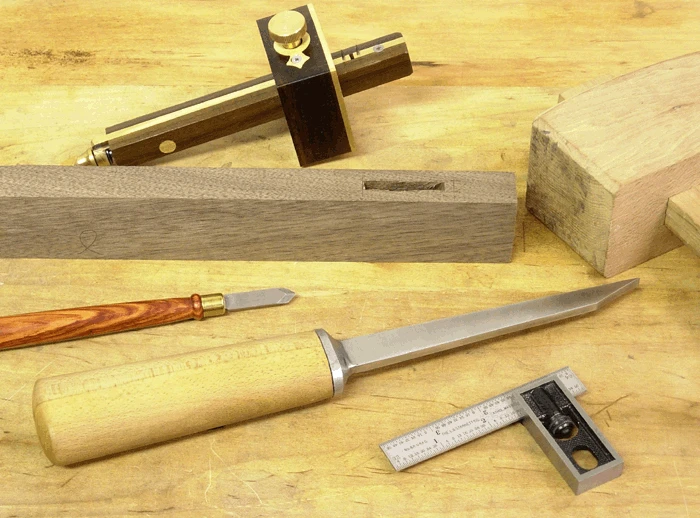
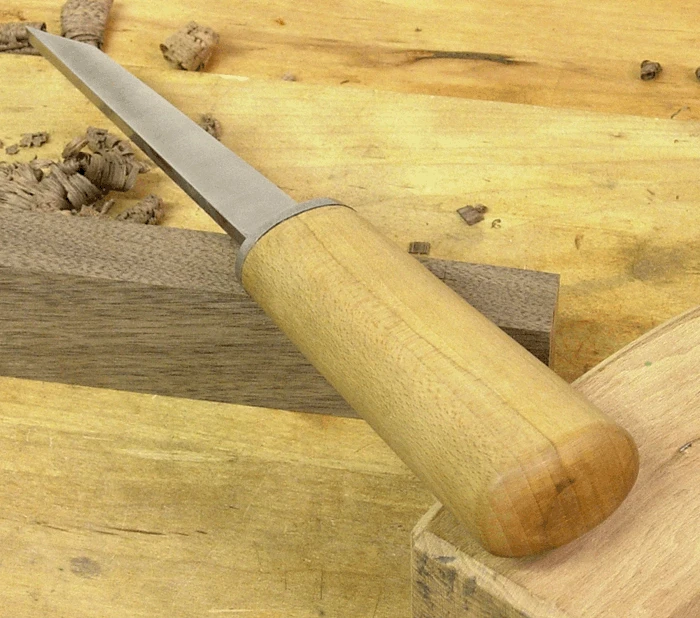
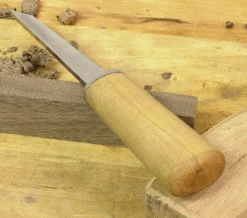
The last time anyone offered a real English-style mortise chisels was in the early 1960’s. There are companies still making sash mortise chisels, and heavy duty sash mortise chisels, but the real thing has been elusive for awhile. Ray has nailed down the essential features of the tool. His chisel is mostly indestructible. It’s designed for the ultimate bashing with a heavy wooden mallet. The ferrule-less beech handles transmit a huge amount of force directly into the heavy steel bolster. You can really see Ray’s attention to detail and skill as a craftsman in the handles. They’re oval, so you will automatically hold the chisel aligned with the mortise without even thinking about it. Traditionally, the best handles were tapered and proportional to the tool size, which made them a lot easier to hold. It just feels right. The oval shape gives a lot more strength in the pulling direction but still remains comfortable.
The sides of the chisel form a slight trapezoid, so that if your chisel isn’t perfectly aligned with the cut you won’t damage the sides of the mortise, and more importantly, there is a lot less of a chance for the chisel to get stuck. You just push the chisel in the mortise a little and it loosens up. Lighter sash mortise chisels are ground parallel but that’s because they are designed for shallower mortises in window sashes which are usually in soft wood. Some manufacturers say that that parallel sides make it easier to guide and align the chisel with the mortise but in fact the alignment of the mortise is determined by the first stroke of the blade into the wood, long before the sides of the chisel can have any effect.
The primary bevel on the chisel is ground to a very narrow 20 degree angle. This of course is not a strong enough angle to hold up to vicious chopping, but it’s historically accurate because the narrow angle lets a blow on the chisel push the chisel very deep. And that’s what we want – to go as deep as possible with each blow. But of course we have to strengthen the tip or it will bend. So mortise chisels need a hefty secondary bevel at the tip or around 35 degrees. It turns out with D2 steel (see below) we can use a very tiny secondary bevel. It works great and it reinforces the shallowness of the primary angle so these chisels can get even deeper per blow than the old antiques. All you need is a tiny secondary bevel, even a 1/16″ is fine. In general we recommend that when you sharpen just sharpen the secondary bevel and it will grow wider. If it gets annoyingly wide just regrind the primary bevel at 20 degrees.
On some early 19th century mortise chisels the primary bevel is rounded into the front edge of the chisel. This makes is easier to lever out waste on deep mortises. We recommend it but decided that since not everyone will want this feature and it’s easy enough to add yourself we left it off the new chisels. Ray rounded the front edge of the chisels a little to make it easier to hold.
We did have a question about what metal to use. There were a couple of historically appropriate options: hammer-weld a cast steel cutting edge to a mild steel body, or make the entire thing out of cast steel. Real cast steel hasn’t been available since the 1950’s. So what do you do? Regular modern carbon steel would be okay, but we thought that the extra toughness of A2 might be better. But in England, where these chisels are made, A2 is hard to get in the sizes we needed. So we decided on D2, a slightly more expensive, more durable, overall better tool steel. Some people feel that A2 and D2 don’t get as sharp as good traditional carbon steel, but this is less of an issue than it would be in, for example, a paring chisel, since mortise chisels don’t need to be as surgically sharp. And the pummeling required by the mortise chisel’s higher bevel angles makes the extra toughness of D2 a real boon. Ray thought that in D2, these chisels would stay sharp forever. He’s off by a few years but the edge retention on these chisels is amazing.
We are as excited about these mortise chisels as any product we have ever offered. And we’re not alone. Chris Schwarz, the executive editor of Popular Woodworking, had a chance to try the chisels out and had the following response:
“After years of working with perfectly adequate sash mortising chisels, the Ray Iles tool was a complete revelation to me. All of his traditional details -¬ the double-tapered handle, the blade’s tapered sides, the mass ¬- add up to a tool that works astonishingly well. If you’ve never tried a traditional mortiser like the Ray Iles, you’re missing out.”
We are offering 6 sizes of the mortise chisel, singly or in a set.
“Best mortise chisels around.” – Mortise & Tenon magazine
“The mortise chisels are some of the most well-balanced tools that I’ve ever used. The thick shank is solid without being excessively heavy. And, of course, they take and hold the edge. “ – Lonnie Bird
“The best chisel I have ever used.” – Paul Sellers
“Best New Tools of 2005,” Popular Woodworking
| option | 1/8", 3/16", 1/4", 5/16", 3/8", 7/16", 1/2" |
|---|
Be the first to review “English Mortise Chisels By Ray Iles”
Related products
New Products
New Products
New Products
New Products
New Products
New Products
Reviews
There are no reviews yet.